Stone and gravel estimate
Gravel Calculator
200 sq ft spread 4 in deep needs 2.47 cu yd of crushed stone base, about 3.6 tons at 1.48 tons per cu yd. Choose your stone, depth and weight per yard below.
Your estimate
2.47 cu yd
66.67 cu ft of crushed stone base over 200 sq ft at 4 in as spread.
- Tons to order2.47 cu yd × 1.475 tons per cu yd3.6 tons
- Across the printed weights1.48 to 2.03 tons per cu yd for this stone3.6–5 tons
- One ton coversat 4 in deep55 sq ft
- Whole bags instead66.67 cu ft ÷ 0.6 cu ft per bag, rounded up112 bags
Tons use the weight in the box, which is a producer’s estimate for loose stone. A yard that sells by the ton weighs the load, so compare with your supplier’s figure before ordering.
How to calculate how much gravel you need
- Measure the area. The example is 20 ft × 10 ft, which is 200 sq ft. For a curved path or an L-shaped drive, split it into rectangles and add their areas.
- Multiply the area by the depth in inches and divide by 12: 200 × 4 ÷ 12 = 66.67 cu ft.
- Divide by 27 for cubic yards: 66.67 ÷ 27 = 2.47 cu yd. That is the volume a yard delivers, whatever the stone.
- Multiply by the weight of a cubic yard of your stone to get tons: 2.47 × 1.475 = 3.64 tons for crushed stone base. The weight is the soft number here; the table below shows how far producers differ.
- If the depth you typed is the finished, compacted layer, divide the volume by 0.75 before step 3. Penn State’s handbook turns an 8 in loose lift into 6 in; 200 sq ft finished 4 in deep then takes 3.29 cu yd.
Cubic yards come from arithmetic alone; tons come from a weight per cubic yard that each producer prints a little differently, so the weight is a box you can overwrite. WSDOT Design Manual, Exhibit 620-1 (Sep 2024); Penn State Driving Surface Aggregate Handbook (2025); Sakrete All Purpose Gravel data sheet
- Weight of crushed stone base, truck measure
- 1.475 tons per cu ydWSDOT Design Manual, Exhibit 620-1 (Sep 2024)
- A loose lift once compacted
- 8 in becomes 6 in, 75% of the loose depthPenn State Driving Surface Aggregate Handbook (2025)
- Base under a walk or slab
- 2–4 inSakrete All Purpose Gravel data sheet
- Driving surface, laid loose
- 6–8 inPenn State Driving Surface Aggregate Handbook (2025)
- One bag of all-purpose gravel
- 0.6 cu ftSakrete All Purpose Gravel data sheet
Gravel per 100 square feet by depth
| Depth | Cubic feet | Cubic yards | Tons | 1 ton covers |
|---|---|---|---|---|
| 1 in | 8.33 | 0.31 | 0.46 | 220 sq ft |
| 2 in | 16.67 | 0.62 | 0.91 | 110 sq ft |
| 3 in | 25 | 0.93 | 1.37 | 73 sq ft |
| 4 in | 33.33 | 1.23 | 1.82 | 55 sq ft |
| 6 in | 50 | 1.85 | 2.73 | 37 sq ft |
| 8 in | 66.67 | 2.47 | 3.64 | 27 sq ft |
A hundred square feet at an inch deep is 0.31 cu yd; every added inch adds the same amount again. Read a depth off this table, scale it to your area, and compare it with the form above.
Driveway gravel calculator: size, depth and tons
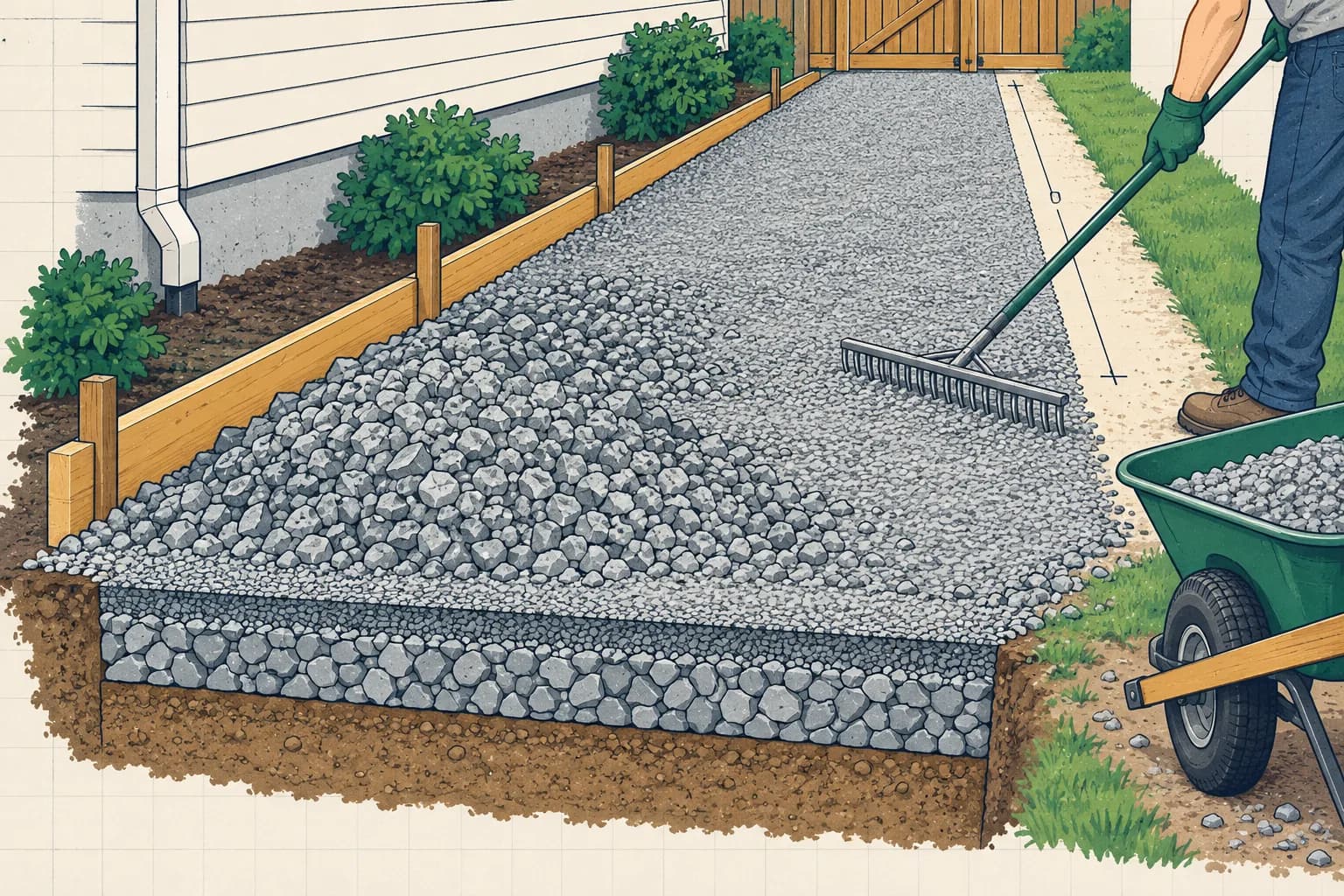
A driveway is a long rectangle, so the arithmetic is the same: length times width, then depth. What differs is the depth. Penn State’s driving surface aggregate handbook asks for a 6–8 in layer laid loose, which compacts to 4.5–6 in. Penn State Driving Surface Aggregate Handbook (2025) Pick the finished depth in the form to have the loose volume worked out for you.
| Drive | Area | Loose cu yd | Tons | Finished cu yd |
|---|---|---|---|---|
| 30 × 10 ft | 300 sq ft | 5.56 | 8.2 | 5.56 |
| 50 × 12 ft | 600 sq ft | 11.11 | 16.4 | 11.11 |
| 50 × 20 ft | 1,000 sq ft | 18.52 | 27.3 | 18.52 |
A soft or wet subgrade changes what the layer is for, and a drive that carries trucks needs more than a walk does. Treat the table as a quantity for a depth you have already chosen, not as a design.
Pea gravel calculator: area, depth and weight
Pea gravel is ordered by the cubic yard like any loose stone, so the form works for it with “Pea gravel or river rock” chosen. As a decorative layer, the University of Maryland and Mississippi State guides give 1 in for gravel or stone. University of Maryland Extension, Mulching Trees and Shrubs (2023); Mississippi State University Extension, P2301, Table 1 A path or seating area usually goes deeper; 2 in over 100 sq ft is 0.62 cu yd.
The weight is the open question. No document in our data weighs pea gravel by name, so the weight box starts from the nearest listed product, coarse sand and gravel at 1.36 tons per cubic yard. Martin Marietta aggregates calculator Graniterock’s 1 1/2 in round rock is lighter loose, 1.22 tons, and 1.36 tons rodded. The ticket from your supplier outweighs both.
How many tons of gravel are in a cubic yard
| Rock | Screenings | Crusher run base | Coarse stone |
|---|---|---|---|
| Limestone | 1.47 / 1.53 | 1.9 / 1.86 | 1.32 / 1.3 |
| Granite | 1.47 / 1.53 | 1.95 / 1.96 | 1.32 / 1.3 |
| Traprock | 1.6 / 1.67 | 2.15 / 2.16 | 1.4 / 1.38 |
| Sand and gravel | 1.44 / 1.51 | 1.78 / 1.76 | 1.36 / 1.32 |
The two calculators agree to within a few hundredths of a ton on limestone, granite and traprock, and disagree most on sand and gravel. Traprock is the heavy rock; coarse stone with no fines is the light product. Martin Marietta aggregates calculator; Vulcan Materials aggregate tonnage estimator
Where sources disagree
Weight of a cubic yard of crushed stone base
- 1.48 tons per cu yd, WSDOT crushed surfacing base course, truck measureWSDOT Design Manual, Exhibit 620-1 (Sep 2024)
- 1.85 tons per cu yd, WSDOT crushed surfacing base course, compacted on the roadwayWSDOT Design Manual, Exhibit 620-1 (Sep 2024)
- 1.9 tons per cu yd, Martin Marietta base, limestoneMartin Marietta aggregates calculator
- 1.86 tons per cu yd, Vulcan crusher run, limestoneVulcan Materials aggregate tonnage estimator
- 2.03 tons per cu yd, Graniterock base rockGraniterock construction materials calculator
- 1.9 tons per cu yd, Ohio DOT crushed stone, Item 411Ohio DOT Item 411, Table 411.04-1 (2013)
The form starts from WSDOT’s truck-measure weight, 1.475 tons, because a yard of stone is ordered as loose truckloads. The quarry calculators print figures a quarter to a third higher, and WSDOT’s own compacted-in-place weight is 1.85. Type your supplier’s number if the ticket differs.
Weight of a cubic yard of round gravel
- 1.36 tons per cu yd, Martin Marietta coarse, sand and gravelMartin Marietta aggregates calculator
- 1.32 tons per cu yd, Vulcan coarse aggregates, sand and gravelVulcan Materials aggregate tonnage estimator
- 1.22 tons per cu yd, Graniterock 1 1/2 in round rock, looseGraniterock, Southside 1 1/2 in round rock product page
- 1.36 tons per cu yd, Graniterock 1 1/2 in round rock, roddedGraniterock, Southside 1 1/2 in round rock product page
No page in our data weighs pea gravel by name. The box starts from the nearest listed product, coarse sand and gravel at 1.36 tons; Graniterock’s round rock, loose, is lighter.
How deep a gravel layer should be
- 2–4 in, drainage base for walks and slabsSakrete All Purpose Gravel data sheet
- 6–8 in loose, 4.5–6 in compacted, driving surfacePenn State Driving Surface Aggregate Handbook (2025)
- 1 in, gravel or stone as a mulch layerUniversity of Maryland Extension, Mulching Trees and Shrubs (2023)
These are three different jobs, not three opinions of one job. The form starts at 4 in, the top of the drainage base range, and takes any depth you type.
What a bag of gravel covers
- 0.6 cu ft per 60 lb bagSakrete All Purpose Gravel data sheet
- 5 sq ft at 1.5 in deep, which is 0.63 cu ftSakrete All Purpose Gravel data sheet
Both lines are on one data sheet and the coverage row sits against a 0.5 cu ft bag. The form divides by the 0.6 cu ft yield; change it to the volume printed on your bag.
Before you order
Ask the yard whether it sells by the ton or by the yard, and which weight it uses. A load weighed on the scale decides the bill, and it can differ from every figure on this page.
Gravel under a patio is counted twice: once for the base and once for the bedding course. The paver patio calculator gives both in tons, and the concrete slab calculator adds the crushed stone under a poured slab. Stone around fence posts is in the fence calculator.
A wall holding back a slope needs base stone below it and drain stone behind it; the retaining wall calculator counts both. If the stone is a decorative layer in a planting bed, one inch is the depth university guides give, and the mulch calculator does the volume.
The form starts at 4 in; change the depth, the stone and the weight for the job in front of you.
Gravel quantity questions
How much gravel do I need for 200 square feet?
200 sq ft spread 4 in deep is 66.67 cu ft, or 2.47 cu yd. In crushed stone base that weighs about 3.6 tons at 1.475 tons per cu yd. At 2 in the same area needs half as much.
How many tons of gravel are in a cubic yard?
It depends on the stone. The producer calculators in our data print 1.3 to 1.4 tons for clean coarse stone and 1.76 to 2.16 tons for base.
For a truckload ordered by the yard, WSDOT’s truck-measure weight for crushed base is 1.475 tons per cu yd.
How do I calculate gravel for a driveway?
Multiply length by width for square feet, then by the depth in inches and divide by 12. A 12 ft × 50 ft drive with a 6 in loose layer is 11.11 cu yd, about 16.4 tons of crushed stone base. Penn State asks for a 6–8 in loose lift on a driving surface.
How deep should a gravel driveway be?
Penn State’s driving surface aggregate handbook calls for 6–8 in laid loose, which compacts to 4.5–6 in. Sakrete suggests only 2–4 in for a walk or slab base. The depth for your soil and traffic is a local call.
How much does a cubic yard of pea gravel weigh?
No document in our data weighs pea gravel by name. Producers print 1.22 to 1.36 tons per cu yd for coarse sand and gravel and for round rock, so a yard of pea gravel is likely in that range. Ask the yard for the ticket weight.
How many square feet does a ton of gravel cover?
At 2 in deep a ton of crushed stone base covers about 110 sq ft, and at 4 in about 55 sq ft, using 1.475 tons per cu yd. Denser stone covers less.
How many bags of gravel make a cubic yard?
A cubic yard is 27 cu ft, so 45 bags of 0.6 cu ft, the Sakrete all-purpose gravel yield. Bags suit a small bed; past one cubic yard, bulk delivery is how stone is usually bought. QUIKRETE ships its 50 lb gravel 56 bags to a pallet.
Do I need extra gravel for compaction?
Yes, when the depth you want is the finished layer. Penn State’s lift shrinks to 75% of its loose depth, so 200 sq ft finished 4 in deep takes 3.29 cu yd rather than 2.47. The calculator does this when you choose after compacting.
A planning aid, not an engineering calculation: your local code and building inspector have the final word. Terms