New lawn quantity estimate
Sod Calculator
1,000 sq ft of lawn plus 10% for cuts is 1,100 sq ft of sod: 3 whole pallets at 450 sq ft each. Change the supplier sizes below.
Your estimate
3 whole pallets
1,100 sq ft of sod including 10% extra for cuts.
- Measured lawn1,000 sq ft
- Order areaArea plus cutting allowance1,100 sq ft
- Pallets before roundingAt 450 sq ft per pallet2.44
- Area delivered by whole pallets1,350 sq ft
- Surplus over measured areaIncludes the cutting allowance and whole-pallet rounding350 sq ft
- Individual pieces insteadAt 5 sq ft per piece; an alternative to the pallet count220 pieces
Pallets and individual pieces are alternative ways to buy the same area; do not add both counts. Suppliers may sell partial pallets.
How to calculate sod for a new lawn
- Measure each lawn patch in square feet. Use length × width for rectangles, or enter the sum of separately measured shapes.
- Add a cutting allowance: 1,000 sq ft × 1.10 = 1,100 sq ft to order in the example. The percent is editable.
- Divide the order area by the square feet per pallet and round up if buying only whole pallets. Divide by the square feet per slab or roll for an alternative piece count. Do not add those purchases together.
- Typical pallet coverage
- 450–500 sq ftMississippi State University Extension, Sod Installation (P2951, 2025)
- Example mini roll
- 5 sq ftSod Solutions, Sod University: square feet per pallet
- Cutting allowance in form
- 10% — editable exampleOur default; change it above
Sod pallets for common lawn sizes
| Measured lawn | Area including cuts | Whole pallets | Mini rolls instead |
|---|---|---|---|
| 500 sq ft | 550 sq ft | 2 | 110 |
| 1,000 sq ft | 1,100 sq ft | 3 | 220 |
| 2,000 sq ft | 2,200 sq ft | 5 | 440 |
| 5,000 sq ft | 5,500 sq ft | 13 | 1100 |
Whole-pallet rounding creates unused area. If the supplier sells loose slabs or part pallets, use the square-foot order area rather than the whole-pallet number to request a quote.
Pallet, slab and roll sizes differ by supplier
Mississippi State University Extension says a typical pallet covers 450–500 sq ft. Sod Solutions lists a broader 400–700 sq ft range across its formats, plus 2.66 sq ft slabs, 5 sq ft mini rolls and 10 sq ft large rolls. Type the size printed on your quote. Mississippi State University Extension, Sod Installation (P2951, 2025); Sod Solutions, Sod University: square feet per pallet
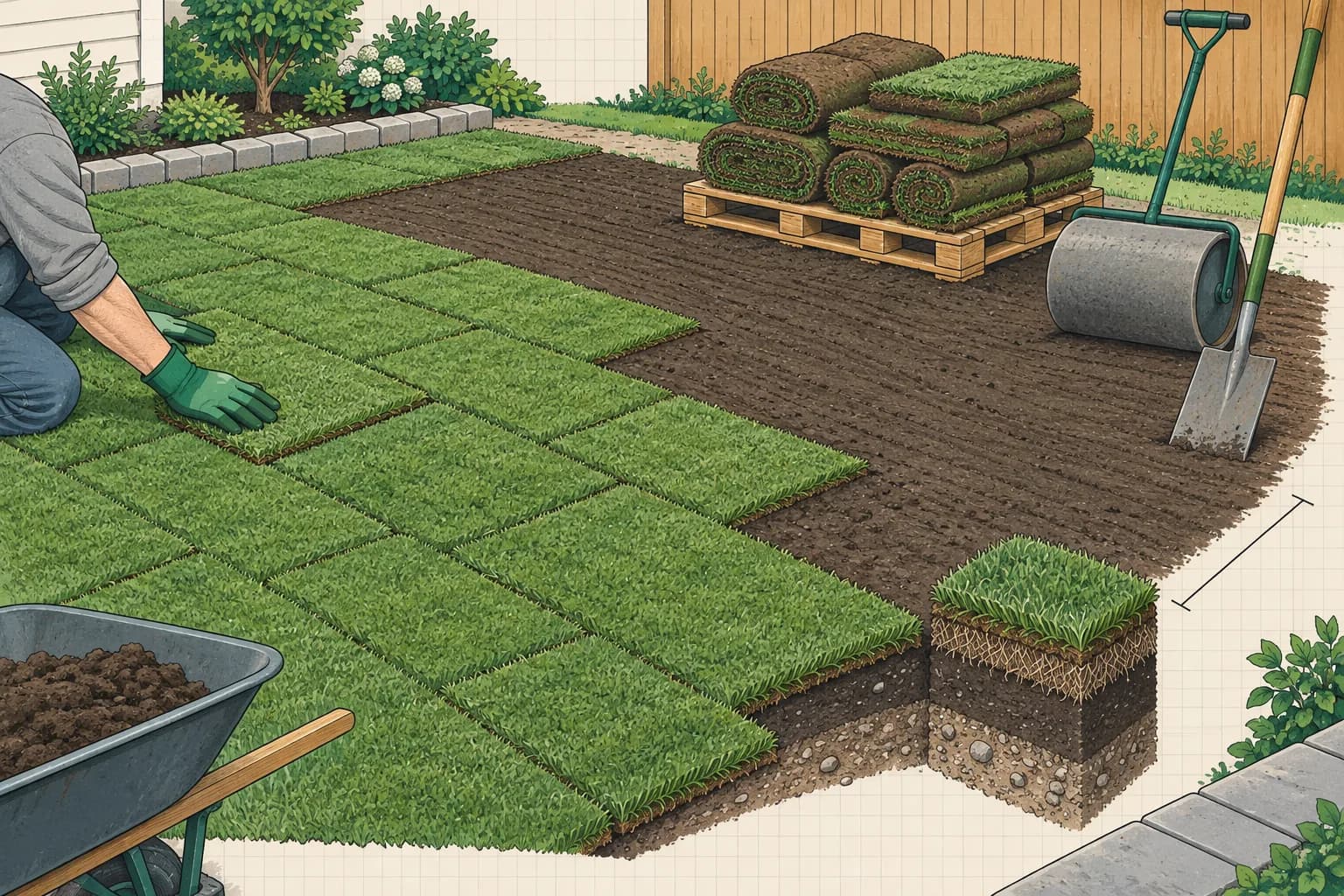
Before delivery
Confirm the pallet’s exact coverage, whether partial pallets are sold, and the delivery weight. One extension guide says a pallet can weigh up to 1 short ton; another supplier lists 1,500–3,000 lb across products. Plan a suitable delivery point and install sod promptly according to the seller’s instructions. Mississippi State University Extension, Sod Installation (P2951, 2025); Sod Solutions, Sod University: square feet per pallet
Sod order questions
How many pallets of sod do I need for 1,000 square feet?
With 10% allowed for cuts, order 1,100 sq ft. At 450 sq ft per pallet, that is 3 whole pallets. Ask whether the supplier sells part-pallet quantities; this result rounds whole pallets up.
How many square feet are on a pallet of sod?
Mississippi State University Extension says a pallet typically contains 450–500 sq ft. Supplier formats can be outside that range; enter the exact area on your quote.
How many rolls or slabs of sod do I need?
At 5 sq ft per mini roll, the 1,100 sq ft example needs 220 rolls including the cutting allowance. Sod Solutions also lists 2.66 sq ft slabs and 10 sq ft large rolls. Select the piece size your supplier actually sells.
Should I add extra sod for cuts?
An allowance can cover cuts around paths and beds; 10% is only an editable example. Measure irregular patches separately and ask the supplier about minimum order increments and return policy.
How much does a pallet of sod weigh?
Mississippi State University Extension says up to 1 short ton per pallet; another seller gives 1,500–3,000 lb across formats. Get the delivery weight for your order before choosing a vehicle.
A planning aid, not an engineering calculation: your local code and building inspector have the final word. Terms