Paver Calculator for a Patio
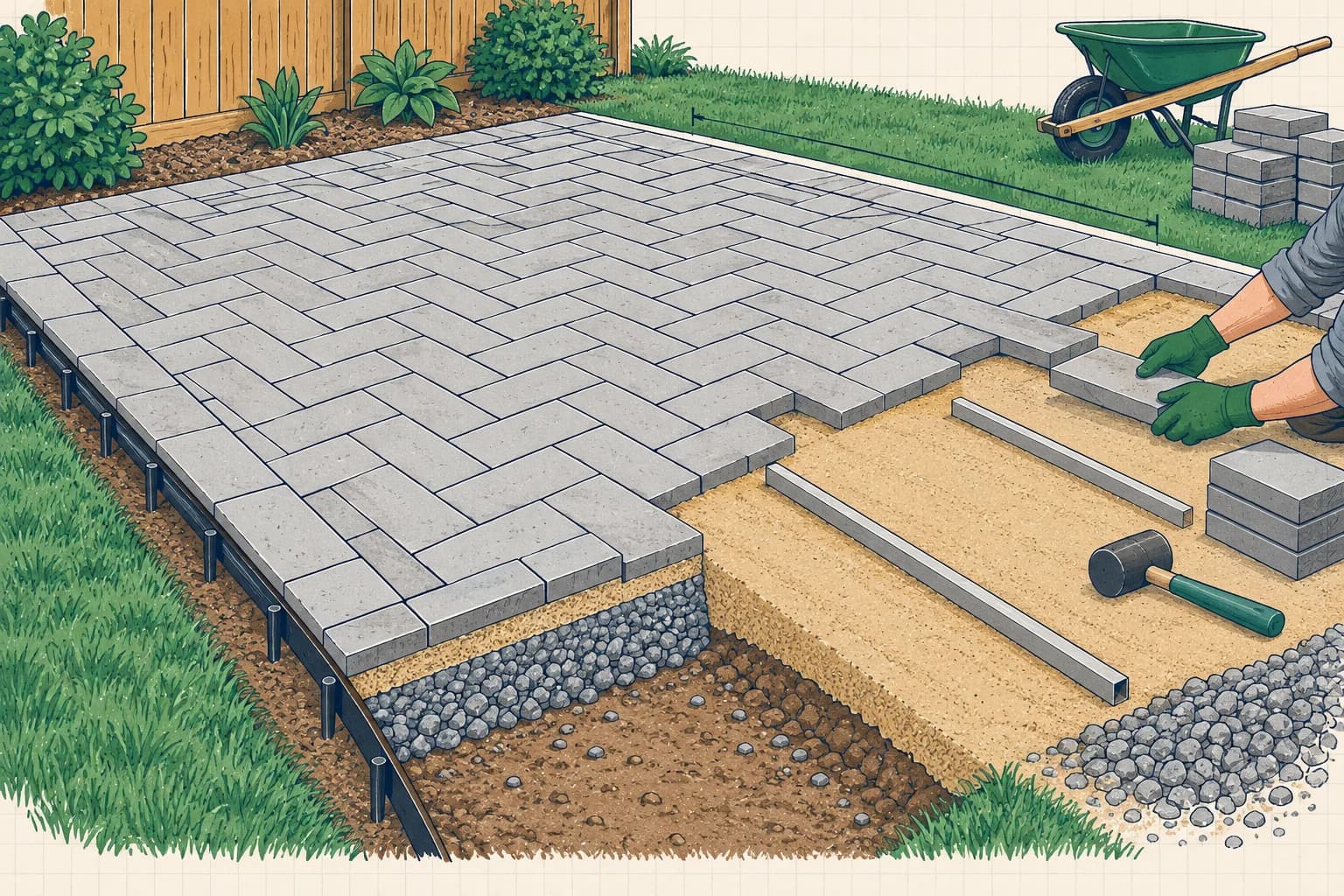
A 16 × 12 ft patio of 4x8 Holland stone needs 940 pavers, 6.6 tons of crushed stone base, 0.9 tons of bedding sand and 3 bags of polymeric sand. Swap the paver or deepen the base to see the list move.
Your plan
- 940paversHolland stone 4x8 pavers
- 6.6tonsCrushed stone base
- 0.9tonsBedding sand
- 3bags50 lb bags of polymeric joint sand
16 ft × 12 ft patio, 192 sq ft: 940 pavers, 6.6 tons of base
Example changeGravel base 6 in → 8 in: +2.2 tons of base
Shopping list
6 items- Holland stone 4x8 pavers (Pavestone Holland Stone, 60 mm)192 sq ft × 4.66 per sq ft = 895 + 5% spare; about 2 pallets940 pavers
- Crushed stone base3.56 cu yd compacted × 1.85 tons per cu yd; about 4.47 cu yd loose on the truck6.6 tons
- Bedding sand0.59 cu yd × 1.44 tons per cu yd; or 32 bags of 50 lb at 0.5 cu ft each0.9 tons
- 50 lb bags of polymeric joint sand192 sq ft ÷ 65 sq ft per bag3 bags
- Paver edge restraintAll four sides; leave out a side that butts a wall or a slab56 ft
- Landscape spikes for the edge restraintOne every 12 in along 56 ft56 spikes
Check before you build
- Joint sand bags vary with joint width and paver depth; read the coverage on the bag you buy.
- Call 811 a few days before you dig, so buried lines are marked.
How this is calculated
Counts use your measurements and the assumptions below. References beside an item support its input values or rule, not the finished count.
What moves the answer most
- Pavers
- 4.66 per sq ft, 2 3/8 in thick
- Spare pavers for cuts and breakage
- 5%: our default for a plain rectangle; none of our sources prints one
Planner setting or your selection; no external document cited.
- Gravel base
- 6 in compacted
- Bedding sand
- 1 in, screeded, not compacted
Other assumptions (5)
- Weight of compacted base
- 1.85 tons per cu yd
- Weight of loose sand
- 1.44 tons per cu yd
- Joint sand coverage
- 65 sq ft per 50 lb bag, narrow joints
- Edge spikes
- Every 12 in
- Dig below finished grade
- 9 3/8 in: base + sand + paver
How each count is reached
- Holland stone 4x8 pavers (Pavestone Holland Stone, 60 mm)192 sq ft × 4.66 per sq ft = 895 + 5% spare; about 2 pallets
- Crushed stone base3.56 cu yd compacted × 1.85 tons per cu yd; about 4.47 cu yd loose on the truck
- Bedding sand0.59 cu yd × 1.44 tons per cu yd; or 32 bags of 50 lb at 0.5 cu ft each
Sources Martin Marietta aggregates calculator; QUIKRETE Mason Sand data sheet (Oct 2023)
- 50 lb bags of polymeric joint sand192 sq ft ÷ 65 sq ft per bag
- Paver edge restraintAll four sides; leave out a side that butts a wall or a slab
Calculated from your measurements and the listed assumptions.
- Landscape spikes for the edge restraintOne every 12 in along 56 ft
All sources (16)
- Pavestone Holland Stone cut sheet (CM 051v9)
- WSDOT Design Manual, Exhibit 620-1 (Sep 2024)
- Martin Marietta aggregates calculator
- QUIKRETE Mason Sand data sheet (Oct 2023)
- Alliance Gator reference guide (2025)
- Snap Edge paver restraint spike placement sheet
- Unilock Basic Tech Guide (2024)
- Unilock Advanced Tech Guide (2019)
- CMHA PAV-TEC-002-22, Construction of Interlocking Concrete Pavements
- Cambridge Pavingstones product line specs (2026)
- QUIKRETE Polymeric Jointing Sand sell sheet
- Techniseal RG+ polymeric sand data sheet (Canada)
- Vulcan Materials aggregate tonnage estimator
- Graniterock construction materials calculator
- Belgard Mid-Atlantic catalog (2026)
- Nicolock Holland Stone product page
Where sources disagree (6)
Gravel base under a patio
- 6 in to 8 in · Unilock Basic Tech Guide (2024)
- 8 in to 12 in on poorly drained clay · Unilock Advanced Tech Guide (2019)
- 4 in to 8 in · Pavestone Holland Stone cut sheet (CM 051v9)
- At least 4 in on well-drained soil · CMHA PAV-TEC-002-22, Construction of Interlocking Concrete Pavements
6 in, the low end of Unilock's patio range; go deeper on clay.
Bedding sand depth
- 1 in · Unilock Basic Tech Guide (2024)
- 1 in · CMHA PAV-TEC-002-22, Construction of Interlocking Concrete Pavements
- 1 to 1 1/2 in · Pavestone Holland Stone cut sheet (CM 051v9)
1 in, which Unilock and CMHA agree on.
What a 50 lb bag of polymeric sand covers
- 65 to 85 sq ft · Alliance Gator reference guide (2025)
- 75 sq ft · Cambridge Pavingstones product line specs (2026)
- 3 bags per 100 sq ft with 1/4 in joints · QUIKRETE Polymeric Jointing Sand sell sheet
- 60 to 120 sq ft · Techniseal RG+ polymeric sand data sheet (Canada)
65 sq ft, the low end of Alliance Gator's range for narrow joints; wide joints take far more.
Spike spacing along the edge restraint
- 12 in · Snap Edge paver restraint spike placement sheet
- 24 in on an impermeable base · Unilock Advanced Tech Guide (2019)
12 in, Snap Edge's preferred spacing.
Weight of a cubic yard of base rock and of sand
- 1.85 tons, base compacted · WSDOT Design Manual, Exhibit 620-1 (Sep 2024)
- 1.9 tons, base · Martin Marietta aggregates calculator
- 1.86 tons, base · Vulcan Materials aggregate tonnage estimator
- 2.03 tons, base · Graniterock construction materials calculator
- 1.44 tons, sand · Martin Marietta aggregates calculator
- 1.43 tons, sand · Vulcan Materials aggregate tonnage estimator
WSDOT's compacted base and Martin Marietta's sand; ask your yard what its rock weighs.
Pieces per sq ft of a 4x8 paver
- 4.66 · Pavestone Holland Stone cut sheet (CM 051v9)
- 4.5 · Belgard Mid-Atlantic catalog (2026)
- 4.5 · Nicolock Holland Stone product page
4.66, Pavestone's, for the product chosen; check your maker's sheet.
940 pavers · 6.6 tons · 0.9 tons
See listHow pavers, base and sand are counted
The example lays Pavestone's 60 mm Holland Stone over a plain 16 × 12 ft rectangle, on a gravel base under a screeded sand bed. These are the steps, each with its source and the planner's own arithmetic.
Pavers
Pavestone prints 4.66 Holland stones per sq ft, so 192 sq ft is 895 pieces. The plan adds 5% for cuts at the edges, our own share, since none of our sources prints one. A 4x8 stone has the face of a brick, which is why this is the option for a brick-style patio.
Arithmetic 192 sq ft × 4.66 per sq ft = 895 + 5% spare; about 2 pallets = 940 pavers
Gravel base
Unilock's guide puts 6 in to 8 in of compacted gravel under a patio; the plan takes 6 in. It is weighed at WSDOT's 1.85 tons per cu yd compacted, the way a yard sells it. For the same base under poured concrete, use the concrete slab calculator.
Arithmetic 3.56 cu yd compacted × 1.85 tons per cu yd; about 4.47 cu yd loose on the truck = 6.6 tons
Sources Unilock Basic Tech Guide (2024); WSDOT Design Manual, Exhibit 620-1 (Sep 2024)
Bedding sand
Unilock and CMHA agree on 1 in of sand, screeded flat and left loose. Martin Marietta weighs loose sand at 1.44 tons per cu yd.
Arithmetic 0.59 cu yd × 1.44 tons per cu yd; or 32 bags of 50 lb at 0.5 cu ft each = 0.9 tons
Sources Unilock Basic Tech Guide (2024); Martin Marietta aggregates calculator; QUIKRETE Mason Sand data sheet (Oct 2023)
Joint sand
Alliance Gator prints 65 to 85 sq ft for a 50 lb bag on narrow joints. The plan takes the low end, so it errs toward one bag too many.
Arithmetic 192 sq ft ÷ 65 sq ft per bag = 3 bags
Edge restraint
Restraint runs the whole 56 ft perimeter, pinned every 12 in as Snap Edge prefers. Leave out any side that butts a wall.
Arithmetic One every 12 in along 56 ft = 56 ft, 56 spikes
How deep to dig
Add the paver's own 2 3/8 in to the 7 in of base and sand, and you have the depth to dig below finished grade.
Arithmetic 9 3/8 in: base + sand + paver
Where paver sources disagree
Paver makers each print their own base depth and pieces per square foot. The planner lists each value it found beside the one the example uses.
Gravel base under a patio
- 6 in to 8 inUnilock Basic Tech Guide (2024)
- 8 in to 12 in on poorly drained clayUnilock Advanced Tech Guide (2019)
- 4 in to 8 inPavestone Holland Stone cut sheet (CM 051v9)
- At least 4 in on well-drained soilCMHA PAV-TEC-002-22, Construction of Interlocking Concrete Pavements
6 in, the low end of Unilock's patio range; go deeper on clay.
Bedding sand depth
- 1 inUnilock Basic Tech Guide (2024)
- 1 inCMHA PAV-TEC-002-22, Construction of Interlocking Concrete Pavements
- 1 to 1 1/2 inPavestone Holland Stone cut sheet (CM 051v9)
1 in, which Unilock and CMHA agree on.
What a 50 lb bag of polymeric sand covers
- 65 to 85 sq ftAlliance Gator reference guide (2025)
- 75 sq ftCambridge Pavingstones product line specs (2026)
- 3 bags per 100 sq ft with 1/4 in jointsQUIKRETE Polymeric Jointing Sand sell sheet
- 60 to 120 sq ftTechniseal RG+ polymeric sand data sheet (Canada)
65 sq ft, the low end of Alliance Gator's range for narrow joints; wide joints take far more.
Spike spacing along the edge restraint
- 12 inSnap Edge paver restraint spike placement sheet
- 24 in on an impermeable baseUnilock Advanced Tech Guide (2019)
12 in, Snap Edge's preferred spacing.
Weight of a cubic yard of base rock and of sand
- 1.85 tons, base compactedWSDOT Design Manual, Exhibit 620-1 (Sep 2024)
- 1.9 tons, baseMartin Marietta aggregates calculator
- 1.86 tons, baseVulcan Materials aggregate tonnage estimator
- 2.03 tons, baseGraniterock construction materials calculator
- 1.44 tons, sandMartin Marietta aggregates calculator
- 1.43 tons, sandVulcan Materials aggregate tonnage estimator
WSDOT's compacted base and Martin Marietta's sand; ask your yard what its rock weighs.
Pieces per sq ft of a 4x8 paver
- 4.66Pavestone Holland Stone cut sheet (CM 051v9)
- 4.5Belgard Mid-Atlantic catalog (2026)
- 4.5Nicolock Holland Stone product page
4.66, Pavestone's, for the product chosen; check your maker's sheet.
| Calculator | Pavers | Base, tons | Bedding sand, tons |
|---|---|---|---|
| This planner, 6 in base, 5% spare | 940 | 6.6 | 0.9 |
| This planner, 4 in base, no spare | 895 | 4.4 | 0.9 |
| DIYCalcs, 4 in base, no spare | 864 | 4.1 | 0.79 |
Before you dig out the patio
A patio is mostly digging and hauling, so line up the delivery and the locate marks first.
Plan the delivery
A full pallet of Pavestone Holland Stone holds 480 pieces and weighs 2,884 lb. The example needs about 2 pallets, a truck's work with the base rock on top.
Call 811 before the dig
This patio goes 9 3/8 in down. Minnesota's statute asks 48 hours' notice, not counting weekends; Florida's law treats 24 in either side of a mark as the line's zone.
Sources Minnesota Statutes 216D.04 (2025); Florida Statutes 556.105 (2025)
Buy pavers made for it
Pavestone's Holland Stone tests above 8,000 psi. On poorly drained clay Unilock asks 8 in to 12 in of base, which you can set in the options.
Sources Pavestone Holland Stone cut sheet (CM 051v9); Unilock Advanced Tech Guide (2019)
Ask about a permit
None of the city documents we collected sets a permit rule for a patio at ground level, so ask your building department before the dig.
Paver patio questions
How many pavers does a 16 × 12 ft patio take?
940 pavers of 4x8 Holland stone: 192 sq ft at 4.66 a sq ft, plus 5% for cuts. In Belgard's 6x9 the same patio takes 539 pavers.
How many brick pavers do I need for a patio?
The 4x8 Holland stone is the brick-sized option here: 4.66 pieces a sq ft by Pavestone, 4.5 by Belgard and Nicolock, which is 940 pavers for the 16 × 12 ft patio. A clay brick paver brings its own pieces per sq ft and its own thickness from the maker's sheet: the count is the area times that figure, and the thickness is added to the 7 in of base and sand to give the dig depth.
How much base gravel does a 16 × 12 ft patio need?
6.6 tons for 6 in compacted, about 4.47 cu yd loose on the truck. The deeper end of Unilock's range: Gravel base 6 in → 8 in: +2.2 tons of base, 8.8 tons in all. A poured surface over the same area sits on a base of its own, which the concrete slab calculator counts.
How much sand goes under and between pavers?
0.9 tons of bedding sand for a 1 in layer, or 32 bags of 50 lb, and 3 bags of polymeric sand to lock the joints.
How deep should I dig for a paver patio?
9 3/8 in below finished grade for this example, the sum of 6 in of base, 1 in of sand and a 2 3/8 in paver.
How many pallets of pavers cover 192 sq ft?
About 2: Pavestone ships 480 Holland stones on a pallet, enough for 103 sq ft.
Can I calculate pavers for a walkway, a circle or a fire pit?
A walkway is a rectangle: 20 × 3 ft takes 294 pavers of 4x8 stone. A round patio has no box of its own yet, so enter a square of the same area and raise the spare share: 10 ft across is π × 5² = 78.54 sq ft, a square 8.86 ft on a side, which takes 400 pavers with 10% spare for the cuts. The round bed box of the mulch calculator does the same area arithmetic.
Why do paver calculators give different counts?
For this patio DIYCalcs gives 864 pavers and 4.1 tons of base: fewer pieces per sq ft, no spare and a 4 in base. Set this planner to a 4 in base and no spare and it gives 895 pavers and 4.4 tons. For how we choose between printed values, see how we weigh the sources.